

Where Leopards Play and Gemstones Lay- Climbing Adventures in Namibia
Updated: Feb 23
Written by Eric Bergdoll - December 2024
From the moment I first tied in in August 2014, climbing quickly transcended from a hobby to an obsession, completely to the detriment of all career and scholarly aspirations. After dropping out of school for the second time to be a full-time dirtbag climber, I ditched my comfy Pittsburgh apartment for the back of a Subaru in the middle of winter and headed west, driving straight to Moab. Even before that first weekend of climbing Ancient Art and Castleton, I was addicted to the desert. When the Subaru broke down, I traded it for an 80s van. When the van broke down, I graduated to a 60s truck camper. For the majority of 2018-2020, I traveled around working odd jobs found on Craigslist, with climbing being my main focus and sole driving force for all things in life. I followed the standard western US dirtbag circuit- every spring I would descend on the Utah desert, and every summer I would flee the heat. The desert was always calling. When Covid hit I tried to listen to the lockdown thing, landing in my girlfriend of the time’s dad’s girlfriend’s barn in Carbondale, but it only took a few weeks before the desert call became too strong. By mid-April, I was back in Moab.

This ended up being one of the best decisions I ever made. See, it turns out that during lockdown, all the people planning on traveling internationally ignored the talking heads on TV and went to Moab. This was a little inconvenient for the guide businesses in Moab, who canceled the employment for all the staff they had set up. Not to miss out on income, even in a lockdown, the guide companies descended on Swanny Park to rally the dirtbags to join the guiding world.

I was halfway through a beard-trimmer haircut when a soon-to-be friend Nate Folger approached me, saying “Hey, do you want to be a raft guide? We told all our guides to go home and now we’re turning away 6 boats per day... people are still coming…”
This lead to a year and change of Moab guiding, lots of Indian Creek days, and plenty of sweaty tower missions. I ended up getting AMGA training paid for by the company, fast-tracking my path to a professional guiding career and, in turn also fast-tracking my burnout in the sport.
A lot of the time burnout comes on gradually, but in this case, I can point my finger at one singular moment. Looking up at the stack of rocks above my head on "Hoop Dancer" on Hummingbird Spire in the Bridger Jacks, my 30th tower. Trip reports of paralysis and life-changing injuries were running through my head. I felt a mental switch flip. At the notch at the end of the first pitch, my partner Ryan asked “Are you leading the next one?” “All you,” I replied. “I’m out of the headspace on this one.” Sitting in that shady notch feeling the screaming-barfies while being blasted by the late November desert winds, I felt my stoke for climbing disappear like sand in the breeze.

Fast forward to November 2022. For the past two years, I had mostly filled the void left by climbing with kayaking, and It turned out to be something I was much more naturally gifted at. I had been kayaking on and off for the past 8 years, but putting 100+ days on the river a few years in a row had me feeling solid in the boat.
In August 2021 I left the desert to pursue an job offer from a landowner to start a rappelling business on the Big Island of Hawaii. Upon landing, I soon learned the Big Island was an unreported mecca for waterfall kayaking. All the secrets and history were held by Derek, a then-56-year-old South African driving tour guide who hadn’t been in the boat much in the past few years. He showed me the sections he knew about and we had some great days on the river. After much talk, we decided to make the trip to Africa to film a video about his first time running the Zambezi in 26 years... right about when I was born.
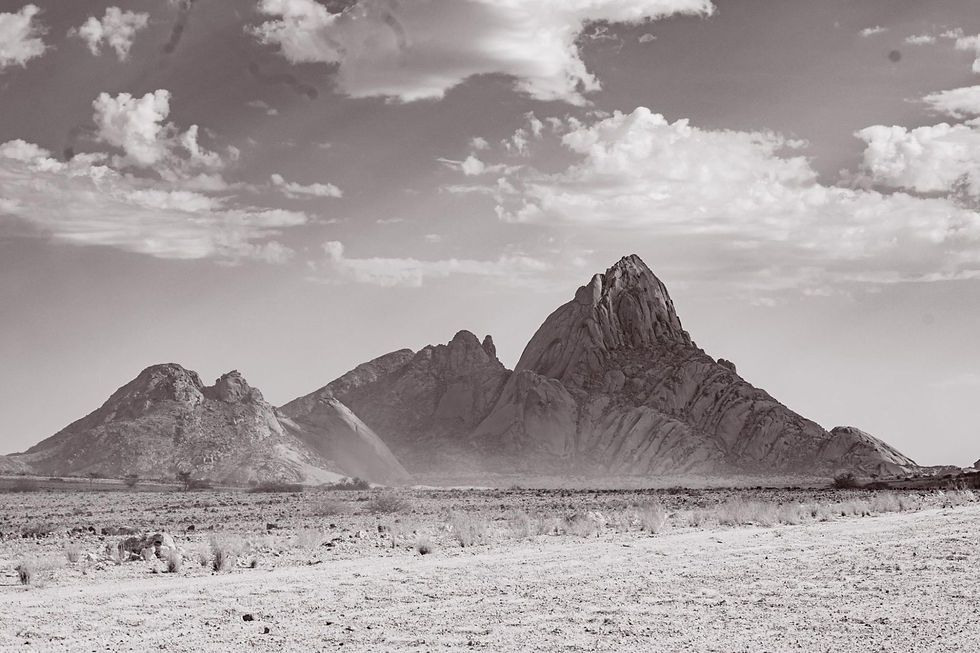
On a layover in the Johannesburg airport, I found a book titled “Geology of Africa.” Flipping through the pages, past the eastern rift valleys, the Sahara desert, and Kilimanjaro, I was stunned when I turned the page and first laid eyes on Spitzkoppe. Thousands of feet of soaring red granite - rising from the flat-pan Namib Desert- a desert thought to be the oldest in the world. At that moment I felt a fire ignite inside me. A feeling I hadn’t felt since my climbing burnout two years prior. The first thing I did was log into Mountain Project and leave a comment on the page looking for a partner for after the Zambezi, to no avail. Dreams of Spitzkoppe were then filed away, into the “would love to someday but unlikely” file of the mind.

Fast forward to March 2024- Jeremiah Morgan, one of the Big Island’s most competent and eccentric, adventure curators, was hanging at my house. We had just finished up SLACKNAC 2024, Big Island’s renegade highline-festival. With a lot of hard work from him and the team and a few warm introductions to landowners, we had just managed to host a section of it fully legally and insured for the first time in its 7 years running.
Over a couple of celebratory beers he began telling me his plans for the next few months.
“So I’m picking up my mainland car in Santa Barbara, going to the Texas Eclipse Festival, then hopefully finding a place to store it, flying to Africa to do an art build for AfrikaBurn..” He began.
“Holy shit, you’re going to Africa? I’m jealous” I interrupted.
“Yeah, want to come?” he replied.
“I’m down, but only if we can try to go climb Spitzkoppe”
After a few pictures, all parties were all in.
Flights booked, plans made, and after a few weeks in the Tankwa Karoo desert with 8,000 others we hopped on a flight from Cape Town to Windhoek Namibia. Why did I just go over a multi-year story about my relationship to climbing before even getting to the main topic of this article? I’m trying to convey that we were both straight off the couch from multiple years away from the sport. Why is this important? We still had a great time and there is plenty to keep entertained in the moderate range. From big peak scrambles to multi-pitch sport climbing, to big wall trad and single-pitch sport, Spitzkoppe has it all. You will still have a blast if you only climb moderates, so long as you enjoy the finer things, like a little slab spice in your life. As a bonus, it is only about a 2-3 hour drive on good roads from the capital city of Windhoek.

“This place has been way too underreported. Think City of Rocks but on a way larger "big wall" scale… nothing more than an insult to phenomenal climbing and better potential.
-James Garrett via Mountain Project

The climbing, setting, and camping is phenomenal. The grain size of the rock was on the larger side, but solid with limited “ball-bearing” feel typical of ancient granite. The walls are rolling seas of seemingly featureless red granite slabs thousands of feet tall, with perfect crystals, edges, and bulges seemingly popping out of nowhere. Campsites are scattered all around the rocks, with many routes beginning feet from camp with no approach. When we were there, there was only one other climbing group. Other than that, the sites were mostly full of older overlanders. There were nice pit toilets all around, just don't forget the toilet paper. Reasonably cheap cold beers, water, local game burgers, and limited pay-per-hour wifi can be found at a restaurant at the entrance. Free showers with hot and cold water were a nice touch, but camping seemed to mostly cater to the overlanding crowd. Bolted anchors allowed for easy rappels back down after summiting. Routes are close enough together that even after missing rappel anchors (like I managed to do multiple times) it's pretty easy to go to ones on a nearby route. The tat situation was awful and was all in desperate need of replacement. It seems like the type of place where chain anchors would be a big benefit on the more popular routes. The bolting on the routes we did seemed reasonably well done and safe, but it does seem like the type of place where you wouldn’t want to take a big fall due to the slabby and remote nature.

That being said, the consequences would probably be scratches and road rash, but not likely serious injury. It reminded me a lot of a big wall Joshua Tree. The wildlife around the camp was also plentiful. "Dassies" were running wild.
At one point, I watched a startled older lady petrified as a dozen or so sprinted circles around her during breakfast time. I couldn’t contain my laughter and it almost brought me to tears. According to the guidebook, after the production of the film “10000 BC” in the area, the producers convinced the local Damara community it was a good idea to fence off the area for “conservation.” Normally many of the animals of the area migrate around in search of water. With no sustainable water sources in the area, this lead to the construction of man-made water sources at great cost to the local community. On their departure, it is said the film crew also “donated” many animals that were not necessarily endemic to the area.
These fences also add difficulties in accessing the normal route and northern-facing routes on Great Spitzkoppe, among others. Sadly, fences were a common occurrence all across Namibia. When I asked a local guide about the fences, he told me they started putting it up after Namibia gained independence from the British Empire in the mid-1990s.

Mountain Project claims the guidebook, “Spitzkoppe and Pontoks Namibia- A Climber’s Paradise” by Eckhardt Haber, is “nowhere to be found” but there were plenty of copies for sale in the first outdoor gear shop we walked into in Cape Town. It took some effort to decipher the lingo, as there isn’t a key for what things like “(N, B, T 3 ,6, P4)” means. Honestly, I’m still not 100% sure what everything means. So far I know “N” means trad, “B” means either fully bolted (or bolted anchors when N is also present) and one of the numbers tells you the number of quickdraws needed. It would be great to have a key. Despite the mildly frustrating grade layout, it still has lots of great routes and information. It is also a little outdated at this point and there are lots of new routes that are not present in it, but the topos and photos make it easy to locate the classics.

Upon landing in Windhoek, we headed straight to the local climbing gym where we met Johnny. Johnny is a local Namibian climber who is visibly passionate about Spitzkoppe. His eyes lit up when telling us stories of camping out, climbing thousand-foot multi-pitch sport routes, and being visited by a leopard family in camp 10b. The gym in Windhoek had pictures of cams on the website, but upon our arrival gear was limited to a few pairs of shoes and prussiks. Johnny told us gear is extremely limited and difficult to get there, which is understandable. For that reason I would suggest bringing it from home, buying last-minute pieces in Cape Town, and bringing something to donate to the community.

This was a bit of an issue for our group as the trad rack didn’t make it to Namibia with us. Upon realizing the lack of gear, we asked Johnny if he would be interested in guiding us up Great Spitzkoppe with gear he could obtain. He told us he did not know the route well enough to feel comfortable doing so.

He also told us there is someone who guides it, but he was recovering from an injury at the time. Slightly disappointed, we changed our plans to the South West Ridge Gully, a scrambling route that ends at the Gendarme 50m below the summit. The same Gendarme that had thwarted many a first ascent party for over 50 years. Even though it didn’t top out, the views from the top were still spectacular.


Next up, we transferred focus to summits that could be attained with sport climbing gear.
Per recommendation from Johnny, Sugar Loaf was next. A formation dwarfed by Great Spitzkoppe and Pontok Spitz ended up being 7 long pitches of moderate but engaging bolt clipping, followed by some scrambling to an unforgettable summit.

After Sugarloaf, a Kudu burger washed down with some Windhoek lagers, a shower, nap, and coffee, we set our sights on the Rhino horn.

The nap may have run a bit long on this one. The climbing was steep, exposed, and full-on engaging. Jeremiah pulled hard leading, and the positioning was sublime. We reached the summit as the light left the sky.


Regarding the “35 meter” fully free-hanging rappel off the back... It might have been closer to 45.
Thankfully I was able to use an MMO to lower Jeremiah as far as he needed to to reach the ground, rig a knot block at that point then tie together every piece of our gear as a pull cord to get our 70m rope back. It ended up being pretty casual, but doing it in the dark added to the excitement.
Overall, the route was amazing, but the crux was most definitely the route finding for onsighting the hike off in the dark. This is a 5-star mini summit and a great way to finish off a day. Granted, it is a lot better if you start and finish at a reasonable time (daylight hours)
All around Namibia, we found the people to be incredibly friendly, but also few and far between. Namibia holds one of the lowest population densities in the world. Overlanding is trendy at the moment, and is also the best way to travel here. Rental bakkies (trucks) such as the one we rented from Advanced 4x4 hire in Windhoek(highly recommended), tend to be kitted out with dual gas tanks to make the long drives between fuel stops less stressful.

It’s a common sight to see a kid standing on the side of the road, seemingly hours from the nearest town, swinging around a water jug. When you stop, the first question that comes out of their mouth usually is “Do you have any water?” then the second is “Do you have any food?” It is a bit rehearsed, but still feels genuine. A little help goes a long way for people living out in the desert. After basic needs are sorted, the conversation usually devolves into “Want to buy some shiny rocks?” Usually, the more pushy folks jump straight into that one. It’s the ones who are more tactful about it all that get you spending money. The ones who lack it spend all their time telling you “You will be my first sale today!” I suggest getting away from those interactions as quickly as possible. The above picture was from the first time we came across the kid on the side of the road trick. The kids were pretty quiet, but the dad’s English was very good. He went straight into his pitch. “Hello, welcome to our village. We are members of the Damara tribe. We speak in clicks! You know, click click click…” I found the click language of the Damara to be one of the most fascinating and unique things of my entire 40-day trip around the world. It is commonly considered one of the oldest and most complicated languages in existence. “We have crystals we have collected for you” he continued. “We look around and find these in the mine around Brandberg mountain.” Brandberg is a large pluton, greater in width and slightly taller than Spitzkoppe, but similar geologically. The ancient magma pushed up from deep in the earth, condensing precious minerals all around the edges. This was another fascinating part of Namibia- the amount of mining.

Most roads are constructed the equivalent of 5-10 lanes wide- with graders constantly creating new lanes through the open desert. See, the way to make a road in Namibia is to take a road grader, point it towards where you want to end up, and drive straight across the desert. This process makes for some dusty roads that usually require about a kilometer of space between vehicles in the absence of a side wind. This is all made more exciting when driving in a caravan, as massive mining equipment could appear out of the dust at any second, with a blast across a loose rock and sand median needed to avoid a head-on collision. Spicy. Mining is the main industry, but tourism is picking up. This is why it is important to get the word out about places like Spitzkoppe. See, the more people who come here to climb and adventure, the more money goes into protecting wild places from mining. To save some wild places, they need to be appreciated. To be appreciated, it just takes more people booking the flight and getting out there. So calling all adventurers… It’s time to book the next one, and Namibia should be high on the list for both adventurous moderate sport climbers to pros.


Comments