

Hydraulic Hazards in Canyoneering: How to Assess Water Risk in Wet Canyons
Canyoneering is inherently dangerous. That shouldn’t surprise anyone—it’s written on every waiver, guidebook, and disclaimer out there, all in the name of avoiding the monster known as “liability.” The phrase has become almost cliché. But when you combine rappelling (already one of the more dangerous aspects of climbing) with marginal anchors, remote terrain, and moving water, things get serious fast.
Once water starts moving, the margin for error shrinks dramatically.
This article introduces a category of risks we’ll call hydraulic hazards. The goal isn’t to make you an expert, but to give you a practical framework for recognizing sketchy situations before you commit. In both canyoneering and whitewater, commitment is often high. Better decisions start with better awareness.
What are hydraulic hazards in canyoneering?
Hydraulic hazards are dangerous water features in canyons caused by flowing water. These include hydraulics (stoppers), siphons, strainers, undercuts, and boils, which can trap, pin, or recirculate a person underwater.

Types of hydraulic hazards
Hydraulics (holes/stoppers) – Recirculating currents at the base of drops that can hold a person underwater or prevent escape by feeding back into the drop.
Siphons/Sieves – Water flowing under rock or into cracks; extremely dangerous and often fatal if entered.
Strainers – Logs or debris that let water pass but trap bodies.
Undercuts– Water pushes into a cave, overhang, or wall
Boils – Upwelling, chaotic water at the base of a drop or water feature
Eddy lines – Powerful current boundaries that can flip, spin, or destabilize.
Narrow slot hydraulics (differential current) – Constricted channels that increase force and speed of water.
Flooding– Sudden increases in flow from upstream rain events.
Overall, these can be broken up into three rough categories:
Hazards that recirculate aerated water
Hazards that let water through, but not a person
Hazards created by differential or changing flows

Assessing Hazards
Start with one key question: Where is the water going?
This is important because even though there might be scary features, they are only really “in play” if the water is pushing through them. With all that being said, deciding what is “in play” is what makes all the difference.
Examples:
A tree fallen in flatwater may be inconvenient, but as long as it is in non-moving water, it isn’t a deadly strainer. When current is introduced, things change.
A small ledge at low flow will allow you to climb up on it and jump off without issue. A little higher, as a boil forms and feeds back into the drop, it can become retentive. Even with a boil, if there isn’t a constriction to the outflow, it will likely spit you out quickly as long as you can stay out of the water feeding back into the drop. As the water gets higher and fills in the “dead space” where aerated water is recirculating behind a drop, it will eventually become a wave, with the recirculated water deep and out of the way.
Being able to identify where the water is going is the most important part of hazard assessment.
How do you tell where the water is going? Watch the bubbles. If the bubbles are making it all the way from one drop to the next, the hydraulic push will be constant and continuous, with little recovery time between. If they are disappearing under a wall, it may be undercut. If they are going back into the curtain of a waterfall or behind, then that is a bad place to be.

It is important to note that just because the pool at the bottom of a drop looks calm… IT CAN STILL BE RETENTIVE… This is a major reason why low-head dams are so dangerous. The uniformity of the ledge creates a boil that is uniform, which means there is little room to let that aerated water escape. This same phenomenon can happen in any hydraulic feature with the right balance of flow, constriction, and uniformity. Aerated water leads to difficulty staying above it and breathing due to its lower density.
In order to survive these differential current situations, one will need to be flushed out with the outflow. The best way to do this is to curl up in a ball and hopefully go deep, past the boil line.
In the world of technical canyoneering, most of the hazards are due to gradient (water falling off of ledges), as opposed to high volume flow (water running over boulders).
For this purpose, I will be focusing mostly on examples related to waterfalls and their associated hazards.

Assessing real-world hazard
(with examples)
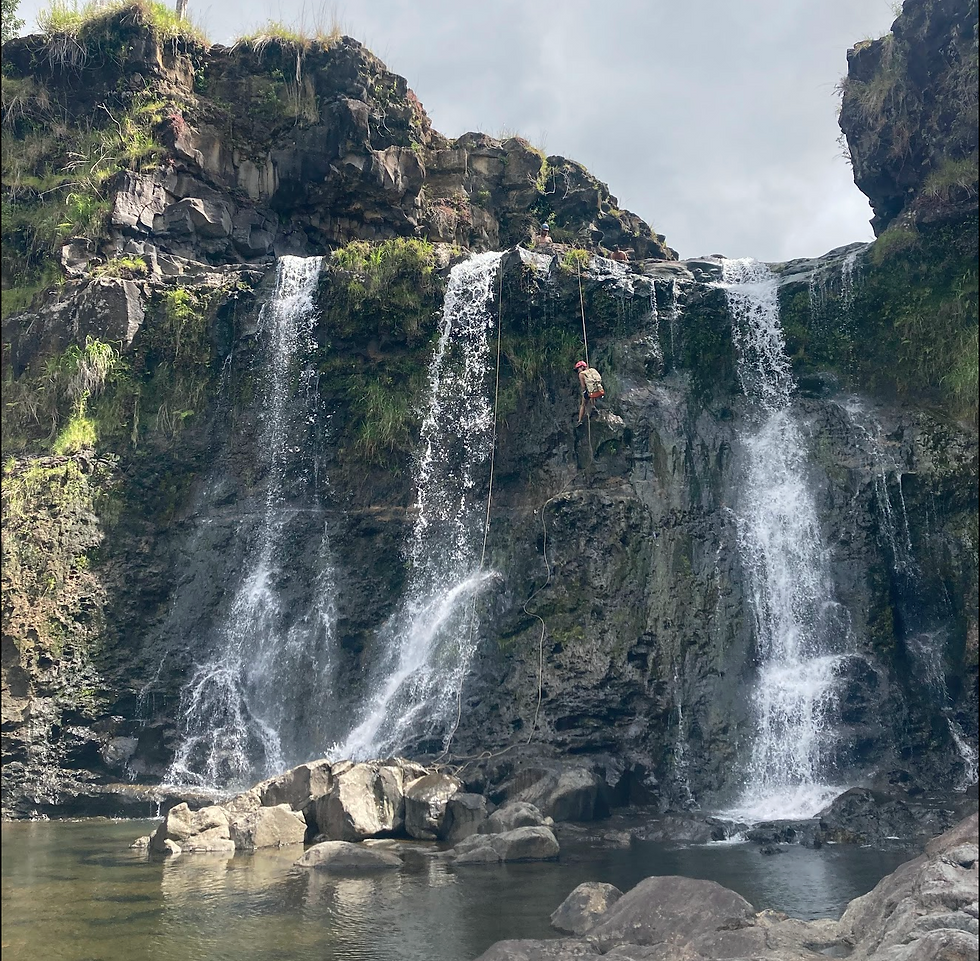
Let's start with a more benign waterfall drop

In this waterfall, we can see that the falling water is broken up into pieces without much of a consolidated line. This separation of water means that there is minimal power to the differential current between the curtain of the falls and the pool. While there is a boil at the base, the distance between the curtain and the boil is minimal, meaning that very little water is being recirculated. In addition, bubbles at the base of the drop are descending into flat water unimpeded, and all the current coming off the falls seems to be accounted for.
Although this waterfall does not create much of a hydraulic hazard at the base, rappelling in even this much current can complicate things significantly. It is easy to get inverted by the water pressure on the shoulders and upper body. The boil at the base can tangle ropes. It is important to have plans in place in case of issues rappelling, as the clock is ticking when someone is getting worked in the flow.
Pro tip: Tucking the chin to the chest will create an air pocket around the mouth in heavy flow conditions. (as per usual, make sure hair is kept far from the rappel device when using this technique)
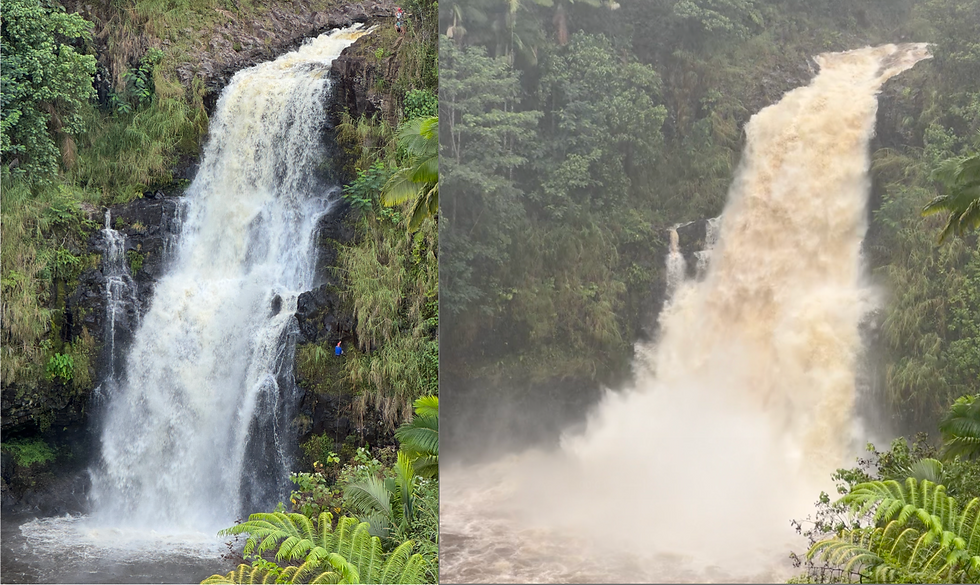
Next, a drop with more obvious hazards:

In this photo, we can see a professional kayaker descending a dangerous hydraulic feature. There is a large boil a substantial distance from the curtain of the waterfall, meaning lots of aerated water is being recirculated. With the solid flow in the curtain, the water is much more consolidated, meaning a larger differential current at the base. The water is highly aerated, and although it is hard to tell by the photo, much of it is moving towards the river-left wall (water unaccounted for) until it reappears lower down near the end of the boil line.
This disappearing act means the wall is undercut, which is a significant hazard. Ending up between the curtain of the waterfall and the boil line will lead to getting pushed left into the cave or the undercut wall. If pinned against the wall, the only option to escape is to go deep and hopefully get pushed downstream. Not a good place to be!

While these are two dramatically different examples, in the real world, most things are somewhere in between. Decision-making in a canyon usually involves a series of escalating decisions. Its important when making these decisions and assessing hydraulic features to weigh each variable both individually and as a part of the big picture. Usually, accidents don’t happen as the result of one bad decision, but a cascading series of events leading to the moment when it all went wrong. It is extremely important with these types of objectives to have contingency plans. Small changes in flow in constricted waterways, like a canyon, can make massive and deadly differences in the experience. It is essential to be able to know if the water is going up or down, and to have bailout plans if conditions change.
Signs that the water may be going up:
Waste and debris are flowing through
Usually, debris such as sticks will be pushed through during the initial rise, and stay stuck or by the high water mark as the river drops. In low-volume waterways, this is a sure sign of rising water
Water is becoming increasingly clouded or changing color
Usually clears up significantly when dropping
Water starts “surging”
small rises and falls, pulsing effect
The flow starts feeling faster
Flash floods are always a massive hazard in canyons. It is important to have backup and exit plans. For the high-commitment endeavors, going during a proper weather window and sourcing information to identify a weather window is a mandatory part of the planning process.
It is important to note that as you follow a watershed, it generally will build in flow. This means hazards may increase as the day progresses. These flowing waterways are also prone to constant change. Things like obstruction to an outflow and the amount of flow can dramatically change the character of a hydraulic feature or make it deadly.

Such was the case with the August 23, 2024 accident that led to the tragic passing of three canyoneers in the “Seven Teacups” canyoneering route in California’s Sequoia National Forest. High flows and a log or rock jam created a siphon that led to all three getting caught and perishing in a bad hydraulic- one after rappelling in and two while attempting to rescue them. As heartbreaking as this story is, it serves as a painful reminder of the dangerous power of water and the phenomenon of “don’t know what you don’t know.”
This article is a brief rundown on a couple of things to look for and is in no way cumulative on all hazards present in waterways. Even if you are an experienced canyoneer, do not attempt canyons with flowing water (class “C” canyons) without a group member experienced in class C canyoneering techniques and swiftwater rescue. If you want to learn more, feel free to contact us at islandmountainguides.com, or even better, join us for a Waterfall Rappelling tour!
Learn These Skills in the Field
Reading about hydraulic hazards is one thing—seeing them in real terrain is another.
If you want to build real awareness of moving water, rope systems, and canyon decision-making, our guided experiences are designed to introduce these concepts in a controlled environment.
Our waterfall rappelling tours on the Big Island combine:
Rope-based access
Moving water environments
Real-time hazard assessment
👉 Check out our guided canyon and waterfall experiences to learn more.
Our Umauma Triple-Tier Waterfall Rappel and River tour is the perfect experience for first-timers or those looking to learn more about hydraulic features and hazards in canyons. We’ll see you on the ropes!


Comments