

The History of Waterfall Rappelling in Hawaiʻi
Waterfall Rappelling in Hawaiʻi: A Thrilling Adventure Awaits
Waterfall rappelling in Hawaiʻi—often called canyoneering or canyoning—is a relatively recent adventure activity layered onto a much deeper relationship between people, water, and steep landscapes. Its history is not a single linear story, but a blend of global climbing techniques, local geography, tourism development, and evolving attitudes toward land access and safety.

Origins: From European Climbing to Global Adventure Sport
Waterfall rappelling ultimately traces its roots to 19th-century European mountaineering. Rappelling (or “abseiling”) was first formalized in 1876 by French climber Jean Charlet, who used ropes to descend steep alpine rock faces. Over time, rappelling became a core technique within the broader sport of canyoning—the practice of traveling through narrow valleys using climbing, swimming, and rope systems.
By the late 20th century, canyoning had spread globally, especially in places with rugged terrain and waterfalls. Hawaiʻi—with its volcanic cliffs, deep valleys, and abundant rainfall—was a natural fit, even if the activity took time to develop there.
Pre-Adventure Tourism: Traditional Hawaiian Relationships with Waterfalls
Before rappelling ever entered the picture, waterfalls in Hawaiʻi held cultural and practical significance:
They were sources of fresh water for agriculture and daily life.
Many were tied to moʻolelo (stories) and spiritual beliefs.
Valleys and streams were traversed carefully, but not for recreation in the modern sense.
Importantly, traditional Hawaiian land stewardship emphasized respect, access rights, and environmental balance—values that still influence how waterfall activities are managed today.
In Hawaiian culture, waterfalls (wailele) are considered sacred, living entities representing wai (freshwater), the source of life and spiritual vitality. They are closely associated with the god Kāne, embodying nature’s power, spiritual cleansing, and the "flow of aloha." These sites often house legends and are viewed as divine rather than merely scenic.
Wai and Life
Wai is the Hawaiian word for freshwater. Because waterfalls are a primary source of this life-giving water, they are revered.
Wahi Pana (Sacred Places)
Many waterfalls are wahi pana, sacred spots with deep spiritual connections where ancestors once gathered or performed rituals.
Deities and Legends
Waterfalls are often linked to spirits or goddesses. For example, Rainbow Falls (Waiānuenue) is traditionally believed to be the home of Hina, the goddess of the moon.
In addition, the town name "Hilo" means knotted or twisted rope in the Hawaiian language.
According to Hawaiian tradition, the town of Hilo received its name from a moment involving Kamehameha I and the twisting of a rope made from tī leaves.
While camped near the Wailuku River, Kamehameha left his attendants to guard his canoe as he traveled inland. As the tide began rising, the men feared the canoe would drift away. One attendant taught the others a special method of twisting soaked tī leaves into strong cordage — a technique called “hilo,” meaning “to twist” or “to braid.” They secured the canoe and went searching for Kamehameha.
When Kamehameha returned and learned how they had protected the canoe, he recognized the distinctive rope-making style from Waipiʻo. Impressed, he named the place “Hilo” in honor of the twisting method.
The story later became symbolic of Kamehameha’s unification of the Hawaiian Islands: just as many fibers are twisted together into one strong rope, Kamehameha brought separate islands, chiefs, and people together into a single kingdom.
The “hilo” lei became a metaphor for strength through unity.
Divine Connection
Waterfalls represent the flow of water from the mountains to the sea, connecting different areas of life and nature.

Early Exploration: Late 20th Century Canyoneering
Modern waterfall rappelling in Hawaiʻi likely began informally in the late 20th century:
Experienced climbers and outdoor enthusiasts began exploring remote valleys.
Techniques from mainland U.S. canyoning (especially in Utah) were adapted to tropical terrain.
Early descents were largely undocumented and often kept secret due to access issues and safety concerns.
Unlike mainland canyoning destinations, Hawaiʻi’s terrain posed unique challenges:
Heavy rainfall and flash floods.
Dense vegetation.
Fragile ecosystems and private land ownership.
These factors kept the activity niche for decades.
Commercialization: The Rise of Guided Rappelling (2000s)
The biggest turning point came in the early 2000s, when waterfall rappelling transitioned from a fringe activity into a guided eco-tourism experience. A key milestone:
2007: Maui’s first dedicated canyoneering company launched guided waterfall rappelling tours.
These tours introduced the activity to a broader audience by:
Teaching basic rope skills on dry cliffs first.
Progressing to waterfall descents.
Emphasizing safety systems and guided instruction.
By the 2010s, waterfall rappelling had become a recognizable adventure alongside ziplining and helicopter tours.

Expansion Across the Islands
Following Maui’s early adoption, waterfall rappelling spread to other islands, particularly the Big Island:
Guided descents at locations like Kulaniapia Falls, Hawaii's largest and highest-volume rappellable waterfall, became popular.
Tours combined rappelling with hiking, swimming, and rainforest exploration.
The activity was marketed as a mix of adrenaline and nature immersion, with a much smaller environmental footprint than other activities.
Today, waterfall rappelling is often packaged as part of canyoneering experiences, blending multiple outdoor skills into a single excursion. Island Mountain Guides LLC continues to push what is accessible to new levels with its modern techniques and private land access initiatives.

Safety, Access, and Controversy
Despite its growth, waterfall rappelling in Hawaiʻi has always been shaped by important limitations:
1. Land Access
Many waterfalls are:
On private land.
Culturally sensitive areas.
Restricted to prevent environmental damage.
Unauthorized access has led to conflicts with local communities.
2. Natural Hazards
Hawaiʻi’s environment introduces serious risks:
Flash flooding in narrow valleys.
Falling rocks and unstable cliffs.
Strong water pressure at the waterfall bases.
These dangers have led to rescues and, in some cases, fatalities (unguided swimmers, not on professional tours)—prompting stricter regulation and closures in certain areas.
3. Cultural Sensitivity
There is ongoing discussion about:
Respect for sacred sites.
Responsible tourism.
Balancing economic benefits with local values.
Modern Era: Regulated Adventure Tourism
Today, waterfall rappelling in Hawaiʻi is:
Highly structured: Most participants go through licensed tour companies.
Safety-focused: Professional guides adhere to HGC (Hawaii Guided Canyon) standardized techniques, specialized gear, and extensive ongoing training.
Experience-driven: Marketed as a “bucket-list” adventure.
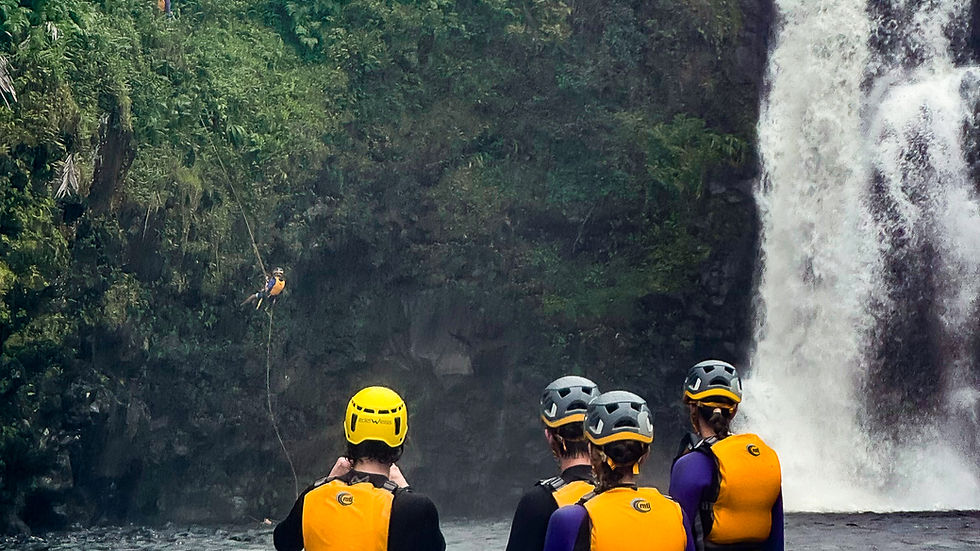
At places like Kulaniapia Falls, visitors can descend over 120 feet alongside cascading water under expert supervision.
At Umauma Falls, visitors can swim and rappel alongside five back-to-back waterfalls as the Umauma River cascades towards the ocean.
The activity has become one of the fastest-growing parts of Hawaiʻi’s broader eco-tourism industry, appealing to travelers seeking immersive, adrenaline-filled experiences with a lower environmental impact.
The Unique Experience of Waterfall Rappelling
Waterfall rappelling offers a unique blend of adventure and cultural immersion. As you descend, you’re not just experiencing the thrill of the drop; you’re also connecting with the rich history and sacredness of the land.
Imagine standing at the top of a waterfall, feeling the cool mist on your face, and hearing the roar of the water below. It’s an exhilarating moment that many adventure seekers crave. The rush of adrenaline is matched only by the beauty of the surroundings.
As you rappel down, you’ll notice the vibrant flora and fauna that thrive in these lush environments. The experience is not just about the descent; it’s about appreciating the natural world around you.
Conclusion: A Young Sport in an Ancient Landscape
Waterfall rappelling in Hawaiʻi allows the intrepid traveler access to some of Hawaiʻi's most inaccessible places, an ancient landscape rich with cultural meaning.
While the techniques come from European climbing and global canyoning traditions, the experience itself is uniquely Hawaiian—defined by lush rainforests, volcanic cliffs, and powerful waterfalls.
Its future will likely depend on how well the industry continues to balance:
Adventure and accessibility.
Safety and environmental protection.
Tourism and cultural respect.
So, are you ready to take the plunge? Waterfall rappelling awaits!


Comments